
NRM top tips - February: restore, regenerate, revegetate

For the month of February, the top NRM tip is: restore, regenerate, and revegetate.
A cotton growers perspective - Jamie Grant
Jamie and Susie Grant own and manage over 2000 hectares across two farms, 'Kielli' and 'Wyalong', located on the Jimbour Brigalow Flood Plains near Dalby in southern Qld.
NRM top tips - January: the month of the European honey bee

For the month of January, the top NRM tip is: think beyond the crop, consider your surrounding natural areas.
To improve the abundance and diversity of natural predators and pollinators (like the European honey bee), consider native vegetation as part of your cropping system. Research shows that native vegetation along field edges can increase pest control in the field, and if pressure is still high, pollination can reduce the yield loss.
For CQ growers: Answering your questions about the first irrigation
Dr Paul Grundy of QDAF and CottonInfo talks first irrigation in a water challenged 2019-20 season for Central QLD growers:
Last season highlighted a diversity of opinions and consternation around first irrigation decisions, as well as whole-of-season irrigation strategies, with the spectre of a dry season ahead and limited water.
Dryland systems: environmental factors and cotton establishment
Considering planting dryland cotton this season? In this article, QLD DAF's Paul Grundy talks about the environmental factors that impact cotton establishment in dryland cotton.
When you break it down, seedling establishment is dependent on two things:
FAQs: limited water scenarios and decisions
Mike Bange, Senior Principal Research Scientist, CSIRO and James Quinn, Marketing & Extension Lead, CSD are often asked questions regarding limited water decisions. Here are their answers to commonly asked questions:
Which configurations yield highest?
Fully irrigated solid planted cotton will out-yield wider row configurations on a per hectare basis NOT necessarily on a per ML basis. (Figure 1).
Defoliation: What do the consultants say?
Defoliation:
CottonInfo's team of Regional Extension Officers surveyed key consultants in their regions to gain insight into how they make the decision to defoliate, to maximise yield and fibre quality. Below is a snapshot of the commentary provided.
Frequently asked questions: Managing silverleaf whitefly and mealybug in cotton
In this blog, Richard Sequeira provides information on silverleaf whitefly (SLW) and solenopsis mealybug for cotton growers in the 2017-18 season.
Whitefly
The TIMS committee has approved a 30-day window for the application of pyriproxifen (Admiral) to control whitefly (SLW) in all cotton growing districts/areas in Australia, beginning in the 2017-18 season:
Q: Why is a 30-day window necessary?
Managing heat stress in cotton
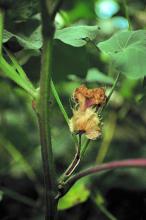
This in turn may cause crops to grow rank following the stress.
Survey to benchmark water use efficiency in cotton (6 October 2017)

Cotton growers are invited to participate in a water productivity benchmarking study, from the NSW Department of Primary Industries (DPI) Agriculture Division, over the 2017-18 season.
The 2017-18 survey, which is delivered with support from the Cotton Research and Development Corporation (CRDC), follows on from similar surveys in 2006-07, 2008-09 and 2012-13, which found that the cotton industry has achieved a 40 per cent increase in water productivity since the study conducted by Tennakoon and Milroy (2003) (0.79 bales per megalitre) 10 years earlier.
Cotton growers' corridor planting contributes to natural pest control (16 Aug 2017)
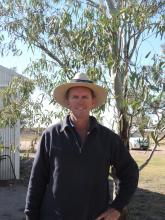
In 2001, in partnership with Greening Australia and the Australian Government's Envirofund, cotton growers Geoff and Ally O'Neill planted eight hectares of native trees and shrubs on their cotton property “Lllano” near Bald Hill.
“We wanted to increase the biodiversity on our farm as well as provide a windbreak,” Geoff said. “Fifteen years later we definitely see more birds and lizards and feel the corridors are contributing to natural pest control.”
Before planting the corridors, Geoff fallowed the area for 18 months.